Medicare · A closer look
Why Medicare PPO Choices Shrunk in 2026
General-enrollment Medicare Advantage PPO offerings fell by 190 for 2026, about 12%. Understand the cost pressures, payment changes, and what to check if your plan ends.
On this page
There really are fewer Medicare PPO plans for 2026. Nationally, general-enrollment Medicare Advantage PPO offerings fell from 1,631 in 2025 to 1,441 in 2026, a net loss of 190 plans, or about 12%, calculated from KFF's analysis of Medicare plan offerings.
The pullback reflects higher health care costs, changes in how Medicare pays insurers, and decisions to concentrate on plans and markets where insurers expect stronger financial results. It is a significant reduction in choice, but PPOs have not disappeared as a Medicare option.
These figures compare coverage offered for 2025 and 2026. If your notice says your plan ends on December 31, 2026, that is a 2027 coverage change, addressed separately below.
How many fewer PPO plans are there?
A Medicare PPO is a preferred provider organization, a type of Medicare Advantage plan offered by a private insurer. It is different from Medicare Supplement insurance, also called Medigap.
KFF's published plan-type chart breaks down the 2026 contraction:
- Local PPOs: 1,588 plans in 2025, falling to 1,403 in 2026 (185 fewer).
- Regional PPOs: 43 plans in 2025, falling to 38 in 2026 (5 fewer).
- Combined PPO offerings: 1,631 falling to 1,441, a reduction of 190 plans and an 11.6% net decline.
These national counts include plans with and without prescription drug coverage. They exclude special needs plans, which restrict enrollment to qualifying populations, and employer- or union-sponsored plans. They count distinct plans, rather than counting a plan again in every county where it is sold.
A net decline is not the number of every plan that closed. It is the difference between two years' offerings after additions and withdrawals. A plan can also stop serving your county while continuing elsewhere. Neither the national count nor its change tells you how many PPO choices remain at your address.
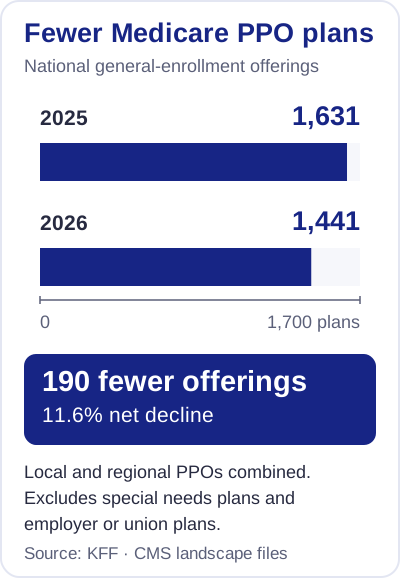
National offerings fell by 190 on a net basis. This is not a count of every PPO termination or of people losing coverage. Includes local and regional PPOs; excludes special needs and employer/union plans. Source: KFF analysis of CMS landscape files.
The broader Medicare Advantage market contracted too. Across general-enrollment plan types, offerings fell from 3,719 to 3,373, a net reduction of 346 plans, or about 9%. That larger figure includes PPOs; it is not an additional 346 PPO losses.
How many people were affected?
The disruption reached well beyond the number of plans. About 2.6 million people, or 13% of people enrolled in individual Medicare Advantage plans with prescription drug coverage in 2025, had their plan coverage terminated for 2026. The previous year's transition affected about 1.3 million people, or 6%, according to KFF's termination analysis.
That is not a PPO-only enrollment figure. It covers different Medicare Advantage plan types and includes plans withdrawing from particular service areas. It excludes special needs plans, employer/union plans, and plans without drug coverage.
Losing a particular plan also does not mean losing Medicare itself. KFF found that 98.9% of those affected had at least one Medicare Advantage prescription drug plan available for 2026. But another available plan may have different doctors, drug coverage, costs, and benefits. Having an alternative is not the same as having an equivalent replacement.
Why did insurers pull back?
Health care costs put pressure on plan finances
Medicare Advantage insurers receive payments to cover their members' care. When members use more services or those services cost more than expected, the insurer has less money left for administration, extra benefits, and profit.
KFF's analysis of the 2026 terminations identifies increased use of health care and pressure on margins as reasons insurers reassessed their offerings. UnitedHealthcare also cited rising health care costs when announcing its 2026 plans.
An insurer can respond by changing benefits or prices, reducing a plan's service area, or discontinuing a plan. Different companies can make different decisions in the same market.
Payment rules changed despite a projected payment increase
The explanation is more complicated than “Medicare cut all the funding.” In its final 2026 rate announcement, the Centers for Medicare & Medicaid Services, or CMS, projected a 5.06% average increase in payments from the announced policy changes.
At the same time, 2026 completed the phase-in of an updated risk-adjustment model: the formula that uses members' health information to help determine insurers' payments. CMS estimated that the model revision and a related adjustment together reduced the payment calculation by 3.01%, while changes in quality-related star ratings contributed another 0.69% reduction. Other factors more than offset those reductions in the national average.
That average is not a promise that every insurer or plan receives 5.06% more. Payments depend on local rates, members' health information, and quality-related factors. Higher overall payments can coexist with financial pressure on particular plans, especially when their care costs rise faster than their revenue.
Drug coverage carries a different share of financial responsibility
Many PPOs include Part D prescription drug coverage. The Part D redesign that began in 2025 shifted more responsibility for high drug costs to plan sponsors.
For 2026, sponsors typically pay 60% of covered drug costs in the catastrophic phase, after a member reaches the annual out-of-pocket threshold. Members pay no cost sharing for covered Part D drugs in that phase. The 2026 threshold is $2,100; premiums and non-covered drugs do not count as costs capped by that protection.
This is valuable protection for people with expensive prescriptions, while also changing insurers' budgeting. It is one relevant financial factor, not evidence that the drug cap caused every PPO withdrawal. The drug cap is also separate from a plan's medical out-of-pocket limit.
Insurers are choosing where to invest
Companies are making selective changes, rather than all leaving the same places or abandoning Medicare Advantage entirely. KFF found that insurers exited different sets of counties, pointing to a mix of local market conditions, costs, and company strategies.
Some investment moved toward specialized coverage. Special needs plan offerings grew 19% for 2026, while general-enrollment offerings declined. Those plans are not available to everyone; eligibility depends on the type of special needs plan.
The national data cannot assign a single reason to each PPO that ended. For your specific plan, its notice and the insurer's explanation matter more than a broad market headline.
Is Medicare switching everyone from PPOs to HMOs?
No. Some insurers emphasized HMOs for 2026, including UnitedHealthcare, which announced expanded HMO access. That does not describe every company or county. Nationally, general-enrollment HMO offerings also fell, from 2,066 to 1,911, a decline of 155 plans, or about 7.5%, in the same KFF chart.
The plan types have meaningful differences:
- A PPO generally lets you receive covered care outside its network, usually at a higher cost, and does not require specialist referrals. Confirm the provider will treat you under the plan and check coverage before getting out-of-network care. See Medicare's PPO guidance.
- An HMO generally requires network care, with exceptions for emergencies, out-of-area urgent care, and temporary out-of-area dialysis. Some HMO point-of-service plans allow certain out-of-network care. See Medicare's HMO guidance.
An HMO can fit if its network includes the care you need. A PPO's flexibility can matter if you use out-of-network specialists or spend part of the year elsewhere. Neither label replaces checking the actual plan.
What should you check if your plan changes?
Start by identifying what changed and for which year:
- Your plan continues with changes: Compare its new costs, benefits, drugs, and provider network.
- Your coverage is ending: Check the nonrenewal or service-area notice for the ending date and replacement-coverage instructions.
- Your plan is being consolidated: You may be moved automatically into another eligible plan from the same insurer. Consolidation is different from termination; confirm what the notice says rather than assuming you must reenroll or that nothing important changes.
Then compare replacement options against your own needs:
- Doctors and hospitals: Verify participation in the exact plan, not just the insurer's brand.
- Prescriptions and pharmacies: Check every medication, coverage restrictions, pharmacy network, and estimated annual drug costs.
- Out-of-network care and travel: Check covered services, provider acceptance, and what you would pay away from home.
- Total costs: Compare premiums, deductibles, copayments, and medical out-of-pocket limits. A $0 plan premium does not mean free care; you generally still pay your Part B premium.
Medicare's plan-comparison guidance explains these checks. If you consider Original Medicare instead, account for prescription drug coverage and supplemental coverage: Original Medicare has no annual medical out-of-pocket limit without supplemental insurance.
If your Advantage plan leaves Medicare or stops covering your area and you return to Original Medicare, you may have time-limited rights to buy certain Medigap policies without health-based underwriting. Do not assume every voluntary plan change provides the same protection. Your age, state, situation, and application timing matter; check Medicare's Medigap purchase rules before changing coverage.
Enrollment timing matters too. Annual open enrollment runs October 15–December 7; selections made during that period in 2026 generally start January 1, 2027. For a year-end contract nonrenewal, Medicare lists a separate enrollment opportunity from December 8 through the last day of February of the following year. Other situations have different deadlines. Check the special enrollment rule for your event; an earlier 2026 plan termination does not mean that window remains open indefinitely.
What about plans ending at the close of 2026?
That is the next plan year. In an initial analysis released October 1, 2026, KFF reported that the average beneficiary's general-enrollment Medicare Advantage prescription drug choices fell from 32 for 2026 to 28 for 2027.
Those are average local choices across plan types, not a national PPO count. The 190-plan net PPO decline above belongs to the 2025-to-2026 comparison and should not be treated as a tally of upcoming 2027 PPO losses.
Bring your plan notice, doctor list, and medications to your coverage review. You can compare options through Medicare's Plan Finder, call 1-800-MEDICARE, or get free independent counseling through your State Health Insurance Assistance Program. For help within NavaQuote's service area, explore NavaQuote's Medicare review services.