Medicare · A closer look
Medicare PPO Plan Ending? What to Know About Coverage and Rising Costs
A discontinued Medicare Advantage PPO does not mean Medicare is ending. Learn how to read your notice, separate premium increases, and compare replacement coverage.
On this page
If you received a letter saying your Medicare PPO will not be available next year, the disruption is real. But losing a Medicare Advantage PPO is not the same as losing Medicare itself. A preferred provider organization, or PPO, is a private insurance plan that provides your Medicare benefits. When its contract is not renewed, Medicare says you will return to Original Medicare if you do not join another Medicare Advantage plan before the old plan ends. That does not automatically replace your drug coverage or extra benefits. See Medicare's rules for plans that do not renew.
Higher premiums are a separate issue. Your federal Part B premium, your private plan premium, and what you pay when you use care are different costs. Understanding which one changed helps you compare replacements without mistaking a low premium for equivalent coverage.
Are Medicare PPO plans actually going away?
Some are ending or leaving particular markets. That does not mean Medicare has abolished PPOs nationwide.
For a concrete 2027 example, the Iowa Insurance Division reported on October 15, 2026, that more than 87,000 Iowa beneficiaries had received notices that their Medicare plans were being canceled or discontinued in their counties. That total includes multiple types of Medicare plans, not PPOs alone. The same Iowa announcement specifically identifies the cancellation of Wellmark and Medica Medicare Advantage PPOs.
That is a state-specific example, not a list of changes everywhere. Your available choices depend on your address and the coverage year. A plan ending December 31, 2026, creates a 2027 replacement decision; it is not evidence about how many PPOs ended a year earlier.
For the earlier market shift, see NavaQuote's separate explanation of why Medicare PPO choices shrank for 2026. For your own coverage, start with the actual notice rather than a national headline.
First, identify what your letter says
“Your costs or benefits are changing.” This is usually an Annual Notice of Change, or ANOC. Medicare says plans send it each fall, normally in September, to describe changes effective in January. A higher copayment or premium is not, by itself, a cancellation. Read the ANOC guidance and compare the new terms.
“Your plan will not renew.” Medicare says a Plan Non-Renewal Notice tells you the plan is leaving the Medicare program for the coming year. Look for the ending date and instructions about replacement coverage. If your letter describes a transfer into another plan instead, ask the insurer whether you must take action and what benefits, network, and costs will change.
“Your doctor is leaving the network.” That concerns access to a provider, not necessarily the end of the plan. Ask both the provider and insurer about your options. Do not assume it automatically gives you the same enrollment rights as a nonrenewal: Medicare evaluates some significant network changes for a Special Enrollment Period on a case-by-case basis.
Keep the letter. It can help establish which enrollment rights apply.
There is no single “standard increase” for every Medicare cost
The standard Part B premium is a federal amount
Part B helps cover services such as doctor visits and outpatient care. The Centers for Medicare & Medicaid Services (CMS) determines its premium and deductible annually under federal law; it is not a PPO insurer's renewal rate.
For 2026, CMS confirmed these changes from 2025:
- Standard monthly Part B premium: $185.00 to $202.90, up $17.90 per month, or about 9.7%.
- Annual Part B deductible: $257 to $283, up $26.
For someone paying the standard premium for all 12 months in both years, the premium increase adds $214.80 a year. That calculation does not include a private plan premium, income-related adjustments, penalties, assistance, or costs for care. The Part B deductible is not a monthly charge, and an Advantage plan has its own cost-sharing terms.
CMS attributed the 2026 standard premium and deductible increase mainly to projected price changes and assumed increases in service use. That does not establish a fixed percentage increase every year.
Do not use $202.90 as a confirmed 2027 rate. As of this guide's November 6, 2026 research check, the retrieved Medicare cost schedule still lists 2026 amounts. Check the final CMS announcement and your own premium notice when budgeting for 2027; a forecast is not a final rate.
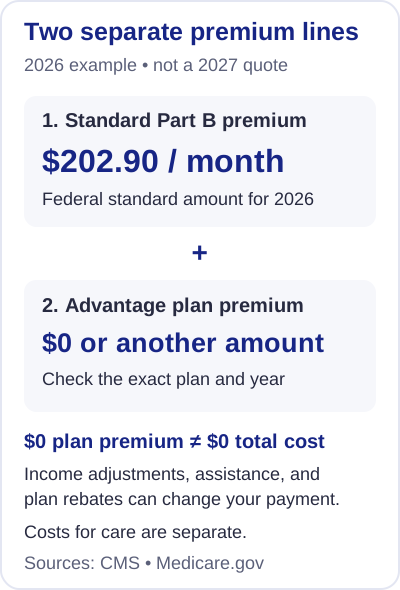
These are separate premium lines, not a total-cost estimate or a 2027 quote. Income adjustments, assistance, and plan rebates can change what you pay. Sources: CMS's 2026 rate announcement and Medicare's coverage comparison.
Advantage and Part D premiums depend on the plan
A private Medicare Advantage plan or stand-alone Part D drug plan does not have one nationwide renewal increase. Your plan's costs can change even when national averages fall.
For example, CMS projected the weighted average Medicare Advantage premium would decline from $14.37 in 2026 to $12.00 in 2027 across its reported plan population, including special needs plans. That is a national projection, not your quote, not a PPO-only figure, and not the Part B premium. It does not mean every member's premium falls or every plan remains available.
You generally continue paying Part B when you join Medicare Advantage. Some plans have a $0 plan premium or help pay part of Part B, but you must check the actual benefit. Medicare's comparison of the two coverage approaches explains why $0 does not mean care is free.
Medigap premiums are another separate cost
Medicare Supplement insurance, also called Medigap, works with Original Medicare, not as a PPO replacement inside Medicare Advantage. Its premium varies by insurer, policy, location, and other factors. Medicare says Medigap premiums typically increase each year; there is no single national percentage that tells you what your renewal will be.
If someone says you face a “standard increase,” ask: Which premium, for which year, and from what old amount to what new amount?
Which enrollment deadline applies if your plan ends?
For fall 2026 decisions, separate these windows:
- October 15–December 7, 2026: Annual Medicare Open Enrollment. A valid plan selection received by December 7 takes effect January 1, 2027, under Medicare's enrollment guidance.
- December 8, 2026–February 28, 2027: The additional window Medicare lists when a plan's contract is not renewed. Other kinds of contract termination have different windows. Match your letter to the specific Special Enrollment Period rule.
- January 1–March 31: Medicare Advantage Open Enrollment is for people already in Medicare Advantage. It is not a general opportunity for everyone in Original Medicare to join an Advantage plan.
A February deadline does not mean your old PPO stays active until February. If it ends December 31, ask when each replacement policy starts. Acting during fall Open Enrollment gives you time to confirm medical and prescription coverage for January 1 rather than relying on a later enrollment opportunity.
If you have employer or union coverage, contact the benefits administrator before making changes.
Compare replacement care, not just replacement premiums
Another Medicare Advantage plan may fit if its network, drug coverage, costs, and service area work for you. A PPO generally allows covered out-of-network care at a higher cost and does not require specialist referrals. Before using an out-of-network provider, confirm coverage with the plan. See Medicare's PPO guidance.
Original Medicare is another approach. It allows you to use providers who take Medicare across the United States, but it has no annual medical out-of-pocket limit without supplemental coverage. Consider a separate Part D plan for prescriptions and whether Medigap or other supplemental coverage is available and affordable. A return to Original Medicare does not automatically purchase those policies for you.
For a fuller comparison, read Medicare Advantage versus a Supplement, alongside Medicare's official coverage comparison.
Check Medigap rights before switching
If your Advantage plan leaves Medicare or stops covering your area and you return to Original Medicare, you may have guaranteed issue rights to buy certain Medigap policies without being denied or charged more because of your health. The policies available and your eligibility depend on your circumstances, age, state, and timing.
For applicable plan-loss situations, Medicare describes an application window beginning 60 days before Advantage coverage ends and ending no more than 63 days afterward. Confirm your specific rights and retain proof of the coverage loss. Federal law generally does not require insurers to sell Medigap to people under 65, although state protections can differ.
A voluntary switch because your premium rose does not, by itself, guarantee the same protection. The one-time federal Medigap Open Enrollment Period does not restart every fall. Confirm eligibility, the actual premium, and the start date before relying on a supplement as your replacement protection.
Bring these five questions to your coverage review
- Will my doctors and hospitals accept this exact plan? Check the plan name and identification number, not just the insurance company's brand.
- Are all my prescriptions covered at my pharmacy? Include dosage, coverage restrictions, and estimated yearly drug spending. If you want drug coverage with a PPO, Medicare says to choose one that includes it; you cannot add a separate drug plan to a PPO that lacks it.
- What will I pay over a year? Compare all applicable premiums, deductibles, copayments, and medical out-of-pocket limits, including out-of-network exposure. Do not count included drug coverage twice.
- What changes during travel or ongoing treatment? Ask about care away from home and arrangements for treatment already underway.
- When does every part of the replacement coverage begin? Confirm medical, drug, and any Medigap coverage separately; keep enrollment confirmations.
Request a Medicare coverage review with NavaQuote. Bring your plan notice, medication list, and preferred providers so you can discuss available coverage around your care needs, budget, and enrollment timing. Service and plan availability depend on your location and circumstances.
For a complete list of options, use Medicare Plan Finder with the correct coverage year, or call 1-800-MEDICARE (1-800-633-4227). Your State Health Insurance Assistance Program offers free, independent counseling. Medicare's plan-selection guidance explains these comparison steps.
If costs are becoming difficult to manage, ask about Medicare Savings Programs for help with eligible Medicare costs and Extra Help for prescription coverage. CMS identifies both assistance options; eligibility matters.
Start with your notice, your medication list, and the providers you want to keep. The goal is not simply to replace the PPO's name on your card. It is to know how your care will be covered, what you may owe, and when the new coverage starts.